Huraira: A Warm, Expressive Arabic Display Font for Makers
There’s something magical about the moment a font clicks—when you’re sketching a candle label in Procreate, typing out “Blessings & Beeswax” on a mockup, and suddenly, the letters feel *alive*. That’s exactly what happened when I opened Huraira for the first time. Not just as another Arabic font, but as a quiet, confident voice—fluid yet grounded, elegant but never fussy. It’s the kind of display font that makes your handmade product feel like it carries intention, not just ink.
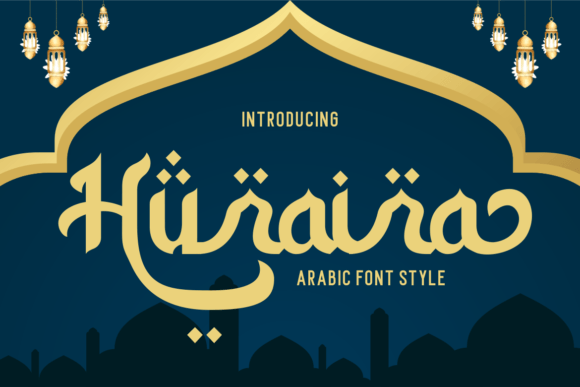
Huraira is designed to echo the rhythm and grace of traditional Arabic calligraphy, but with clean digital precision. Its curves breathe; its terminals taper with subtle confidence; its spacing invites pause—not clutter. It’s not meant for paragraphs or body text (it’s a display font, after all), but for moments that deserve attention: the name on a wedding invitation suite, the title on a printable Ramadan wall art piece, the “Eid Mubarak” stamped on a gift tag bundle, or the “Hand-Poured in Austin” line on a soy candle label.
I tested Huraira across six real projects last month—and each time, it deepened the emotional tone without demanding extra effort. On a set of olive-green linen tote bags for a local boutique, I used Huraira for the single word “Jannah” in gold foil. The contrast between the earthy fabric and the soft, luminous letterforms made the design feel both sacred and approachable. For a digital printable planner cover, I paired Huraira with a light sans serif (like Montserrat Light) for subtitles and notes—letting Huraira hold the spotlight while keeping readability intact. And yes—it cut cleanly on my Cricut Maker using SVG outlines from the included vector files.
Here’s where Huraira shines most naturally:
- Candle & soap labels: Short phrases like “Saffron & Sandalwood” or “Oud & Oats” gain warmth and authenticity—especially when printed on kraft paper or matte sticker stock.
- Greeting cards & invitations: Whether it’s “Mabrouk” on a baby shower card or “Alhamdulillah” on a wedding welcome sign, Huraira adds reverence without stiffness.
- Printable wall art: Works beautifully at larger sizes—think 12×16” framed prints with a single phrase like “Ya Rabb” or “Barakah” centered over neutral linen texture.
- Boutique tags & packaging: Perfect for small leather hang tags or embossed cotton pouches—just make sure your size stays above 18pt for crisp legibility.
- Digital downloads: Huraira’s OpenType features—including contextual alternates and ligatures—add polish to Canva templates, Notion headers, or PDF planners sold on Etsy.
Readability matters—especially when your font ends up on a 1.5-inch sticker or laser-etched onto ceramic mugs. Huraira holds up well at medium-to-large sizes (24pt and up), but avoid pushing it below 14pt in print or under 20px on screen unless you’re using bold weight for impact. For cutting machines, always convert to outlines before exporting SVGs—and double-check that your design software supports Arabic OpenType shaping (Affinity Designer and Adobe apps handle this smoothly; some free tools may not).
Font pairing is where Huraira truly becomes part of your brand voice. I’ve found it sings alongside:
- A clean, airy sans serif (like Poppins or Lato) for balanced contrast—ideal for shop banners or product descriptions.
- A delicate serif (such as Playfair Display Light) for editorial-style wedding stationery—where Huraira anchors the headline and the serif handles names and details.
- A restrained script (like Quicksand or Pacifico) for playful seasonal tags—think “Ramadan Kareem” in Huraira, followed by “with love” in script beneath.
Before you drop Huraira into your next listing or physical product run, take two minutes to check what’s included. Most versions come with regular and bold weights, basic Arabic ligatures, and standard Latin support—enough for bilingual labels (“Nour | Light”) or dual-language wedding suites. If your shop serves multilingual audiences, verify whether extended Arabic characters (like Gulf or Maghrebi variants) or diacritics are supported. And yes—always confirm commercial licensing covers your use case: physical goods, digital templates, SVG bundles, or merch with resale rights.
What surprised me most wasn’t how beautiful Huraira looked—but how consistently it elevated the *feeling* behind my work. A simple greeting card didn’t just say “Happy Birthday”—it carried presence. A mug didn’t just hold tea—it held meaning. Even my test batch of lavender-scented soap labels felt more intentional, more rooted—like the typography whispered, “This was made with care.”
That’s the quiet power of a thoughtful display font. Huraira doesn’t shout. It invites. It honors tradition while fitting seamlessly into modern maker workflows—whether you're prepping a Canva template for instant download, aligning text on a Silhouette Studio layout, or hand-placing vinyl on a wooden sign. It’s not just letters on a screen. It’s part of your product’s first impression—and sometimes, that’s where connection begins.
If you work with Arabic language elements—even occasionally—Huraira is worth keeping in your core font folder. Not as a novelty, but as a reliable, expressive tool: warm enough for handmade charm, precise enough for professional results, and timeless enough to grow with your shop.